Statistical Analyses for Occupational Exposure Results

NIOSH released a guide, Occupational Exposure Sampling Strategy Manual (1977), that describes statistical analyses for occupational exposure results in a clear and concise manner. Included are discussions and examples on:

  • Confidence Limits (CL’s)
  • CL’s and Compliance / Non-compliance Classifications
  • Statistics and Classifications for: full period sampling, partial period sampling, consecutive sampling, grab sampling, comparison to ceiling standards, and more.

If you are looking for a (free) guide that details “real world” occupational exposure statistical analyses, download NIOSH’s guide HERE (NIOSH Occupational Exposure Sampling Strategy Manual (37)).

Join the forum discussion on this post - (1) Posts
Share this Page:
  • Print
  • email
  • Digg
  • Twitter
  • Facebook
  • del.icio.us
  • Google Bookmarks
  • Technorati
  • Yahoo! Bookmarks

Guide to Developing a Hazardous Materials Training Program

This guidance document (A Guide to Developing A Hazardous Materials Training Program – link at the bottom of this post) explains the training requirements in the Hazardous Materials Regulations, identifies those employees who must be trained, and provides a tool to help hazmat employers determine what type of training and training environment may be best for their employees.

Hazardous materials transportation is a process that involves people performing functions related to handling, packaging, storing, moving, loading and unloading of hazardous materials, and responding to emergency situations while such materials are in transportation. It includes employees responsible for the safe transportation hazmat. The process also incorporates functions to design, manufacture, fabricate, inspect, mark, maintain, recondition, repair, or test a package, container or packaging component used in transporting hazardous materials. With such a complex process, the United States Department of Transportation (DOT) has identified human error as a contributing cause for most hazmat transportation incidents.

Continue reading Guide to Developing a Hazardous Materials Training Program

Share this Page:
  • Print
  • email
  • Digg
  • Twitter
  • Facebook
  • del.icio.us
  • Google Bookmarks
  • Technorati
  • Yahoo! Bookmarks

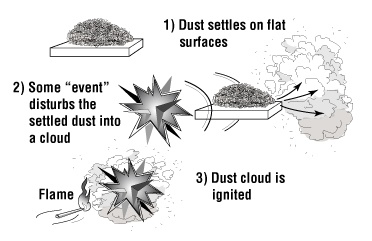
OSHA to Hold Combustible Dust WebChat on June 28, 2010

OSHA invites interested parties to participate in a Web Chat on June 28, 2010 at 1 pm ET on the workplace hazards of combustible dust. OSHA plans to use the information gathered in response to this Web Chat in developing a proposed standard for combustible dust.

Participants are requested to provide their name, affiliation, and e-mail address so OSHA can respond to comments or seek clarification.

Participants can access the Web Chat at http://www.dol.gov/dol/chat.htm. The Web Blog will remain accessible for additional feedback through July 7, 2010.

Join the forum discussion on this post - (1) Posts
Share this Page:
  • Print
  • email
  • Digg
  • Twitter
  • Facebook
  • del.icio.us
  • Google Bookmarks
  • Technorati
  • Yahoo! Bookmarks

ACGIH and AIHA Continue Alliance Discussions for OELs

The American Conference of Governmental Industrial Hygienists (ACGIH) and the American Industrial Hygiene Association (AIHA) announced that they continue dialogue regarding the proposed strategic alliance announced in May 2009 to develop occupational exposure guidelines. With the originally proposed alliance, AIHA would be an industrial hygiene member professional organization, and ACGIH would be a non-member scientific organization. This would most effectively leverage our efforts and resources to protect worker health, while ensuring that all professionals have an opportunity to be involved in supporting and developing the science and practice of industrial hygiene.

Late last year, ACGIH introduced an alternative alliance approach in which ACGIH receives funding from each of several professional occupational health and safety associations whose members have an interest and stake in the development and use of occupational exposure guidelines. More recently AIHA participated in ACGIH®’s direct discussions with key professional associations to gauge interest. These discussions are expected to continue over the next few months.

Source: Thomasnet, AIHA, ACGIH

Share this Page:
  • Print
  • email
  • Digg
  • Twitter
  • Facebook
  • del.icio.us
  • Google Bookmarks
  • Technorati
  • Yahoo! Bookmarks

Average Salaries: Industrial Hygienist, Certified Safety Professional, EHS Manager

Below are the average salaries for occupational health and safety professionals (industrial hygienists, certified safety professionals, and environmental, health, and safety managers) in the US.  The salaries are based upon the average salaries for nationwide  job postings and are a good representation of the salaries available.  Please note that the salaries can have a significant range and depend upon industry, experience and position.

Industrial Hygienist Salary


Continue reading Average Salaries: Industrial Hygienist, Certified Safety Professional, EHS Manager

Share this Page:
  • Print
  • email
  • Digg
  • Twitter
  • Facebook
  • del.icio.us
  • Google Bookmarks
  • Technorati
  • Yahoo! Bookmarks

Calculator: Minimum Sample Volume & Required Sampling Time

Want to determine the Minimum Sample Volume needed to ensure you collect enough of a sample volume so that the results are capable of being less than the Exposure Limit? Want to know how long you need to sample at a given flow rate?

If so, use OHShub.com’s Minimum Sample Volume and Required Sampling Time calculator and take the guess-work out of the equation.

Input the:

  • Laboratory Limit of Quantitation (LOQ)
  • Exposure Limit
  • Desired Fraction of the Exposure Limit (essentially a safety factor for sampling)
  • Sampling Rate

And the results will give you the Minimum Sample Volume and Required Sampling Time.

Note:  Ensure that you have the right units and all of the units are consistent.  Units such as parts per million (ppm) for Exposure Limits may need to be converted to mg/m3.

Download the Calculator HERE: (Calculator: MSV & RST (96))

Share this Page:
  • Print
  • email
  • Digg
  • Twitter
  • Facebook
  • del.icio.us
  • Google Bookmarks
  • Technorati
  • Yahoo! Bookmarks

Attend AIHce 2010 Tech Sessions... Virtually

The American Industrial Hygiene Conference and Expo (AIHce) is the “must attend” event for thousands of industrial hygiene and occupational and environmental health and safety professionals. Spend the day virtually at AIHce and gain:

  • New perspectives and up-to-date research via phone
  • Guided presentations and abstracts over the web
  • Opportunities to interact via question and answer sessions
  • Educational experiences, in short, manageable time frames through out the day.
  • Cost effective training opportunities for individuals, large groups or even local sections
  • “Attend” some of the most fascinating and thought provoking technical sessions at AIHce 2010. Learn via a unique, trend-setting conference experience from the convenience of your home or office. Relax, access and absorb useable information and knowledge you can apply in your own practice!

Get 100% of the same great AIHce experience, certification maintenance points and practical information – with more flexibility and zero travel costs. Hear and see the same Technical Sessions you’d see in Denver! Plus, you’ll be automatically subscribed to the AIHce Virtual Tech Session (AIHA) Community further extending your interactive virtual networking opportunities. Your one-day AIHce Virtual Tech Session registration includes: Continue reading Attend AIHce 2010 Tech Sessions… Virtually

Share this Page:
  • Print
  • email
  • Digg
  • Twitter
  • Facebook
  • del.icio.us
  • Google Bookmarks
  • Technorati
  • Yahoo! Bookmarks

Free Webinar: Work Zone Safety for Highway Construction (ANSI A10.47)

Scott Schneider, director of safety for the Laborers’ Health and Safety Fund of North America and chairman of the work group that developed the New ANSI A10.47 Standard, provided a detailed overview, via a webinar, about this new standard on “Work Zone Safety for Highway Construction”.  This comprehensive standard, effective February 24, 2010,  covers practices including Flagger Safety, Runover/Backover Prevention, Equipment Operator Safety, Illumination, Personal Protective Equipment, and more.

To view a copy of the webinar, click HERE.

A copy of the standard is available on the ANSI Website for $69.00.

Source: WorkZoneSafety.org

Join the forum discussion on this post - (1) Posts
Share this Page:
  • Print
  • email
  • Digg
  • Twitter
  • Facebook
  • del.icio.us
  • Google Bookmarks
  • Technorati
  • Yahoo! Bookmarks

OHShub.com’s CIH Exam Prep Questions to Continue in June ’10

OHShub.com will be taking a short leave from posting examination preparation questions for the Certified Industrial Hygienist (CIH) exam.  Questions will resume in June 2010 after the Spring American Board of Industrial Hygiene (ABIH) exam window has closed.

In the meantime, be sure to check out the over 250 questions that OHShub.com currently offers to use in your study efforts.    Additionally, be sure to stay tuned to OHShub.com as some new and exciting examination preparation materials will soon be available.

Join the forum discussion on this post - (1) Posts
Share this Page:
  • Print
  • email
  • Digg
  • Twitter
  • Facebook
  • del.icio.us
  • Google Bookmarks
  • Technorati
  • Yahoo! Bookmarks

OSHA Releases Chemical Exposure Health Data

OSHA recently released 25+ years worth of industrial hygiene sampling data as a part of the “Open Government” initiative.

OSHA takes industrial hygiene samples as part of its compliance monitoring program. Many of these samples are submitted to the Salt Lake Technical Center for analysis. Sampling data represent personal, area, and bulk samples for various airborne contaminants.

Personal sampling results represent the exposure to the individual who was actually wearing a sampling device. Area samples are taken in a fixed location and results may represent the potential risk from airborne contaminants or physical agents to workers in that area. Bulk samples were taken to verify if certain constituents are present and if so, in what concentration. Bulk samples are used individually or in conjunction with personal or area samples to help interpret the level of worker risk.

OSHA compliance officers do not:

  • Routinely visit every business which use chemicals known to be toxic.
  • Take representative samples of every employee and every activity on every day.
  • Always obtain a sample for an entire (8-hour) period or shift.

OSHA compliance officers do:

  • Target and visit certain industries based on National and regional emphasis programs.
  • Have limited time to conduct an inspection and cannot completely characterize all exposures for all employees, every day.
  • Use professional judgment and often attempt to evaluate worse case chemical exposure scenarios.
  • Develop a snapshot picture of potentially hazardous chemical exposures and use field evaluation tools to assess their significance: often comparing their measured airborne concentrations of chemicals against established standards.

Source:  OSHA.gov

Share this Page:
  • Print
  • email
  • Digg
  • Twitter
  • Facebook
  • del.icio.us
  • Google Bookmarks
  • Technorati
  • Yahoo! Bookmarks